I remember sitting across from Sarah, a client who owns a $4.3M fashion ecommerce store. She was drowning in customer emails, inventory mishaps, and abandoned carts. Then we implemented AI solutions. Within 90 days, her profit margins jumped 34%. That's the power of AI in ecommerce industry. It's not futuristic anymore—it's happening right now. Store owners who embrace these tools are literally printing money while their competitors struggle with manual processes. Let me show you exactly how this works.
1. What Is AI in Ecommerce Industry and Why It Matters Now
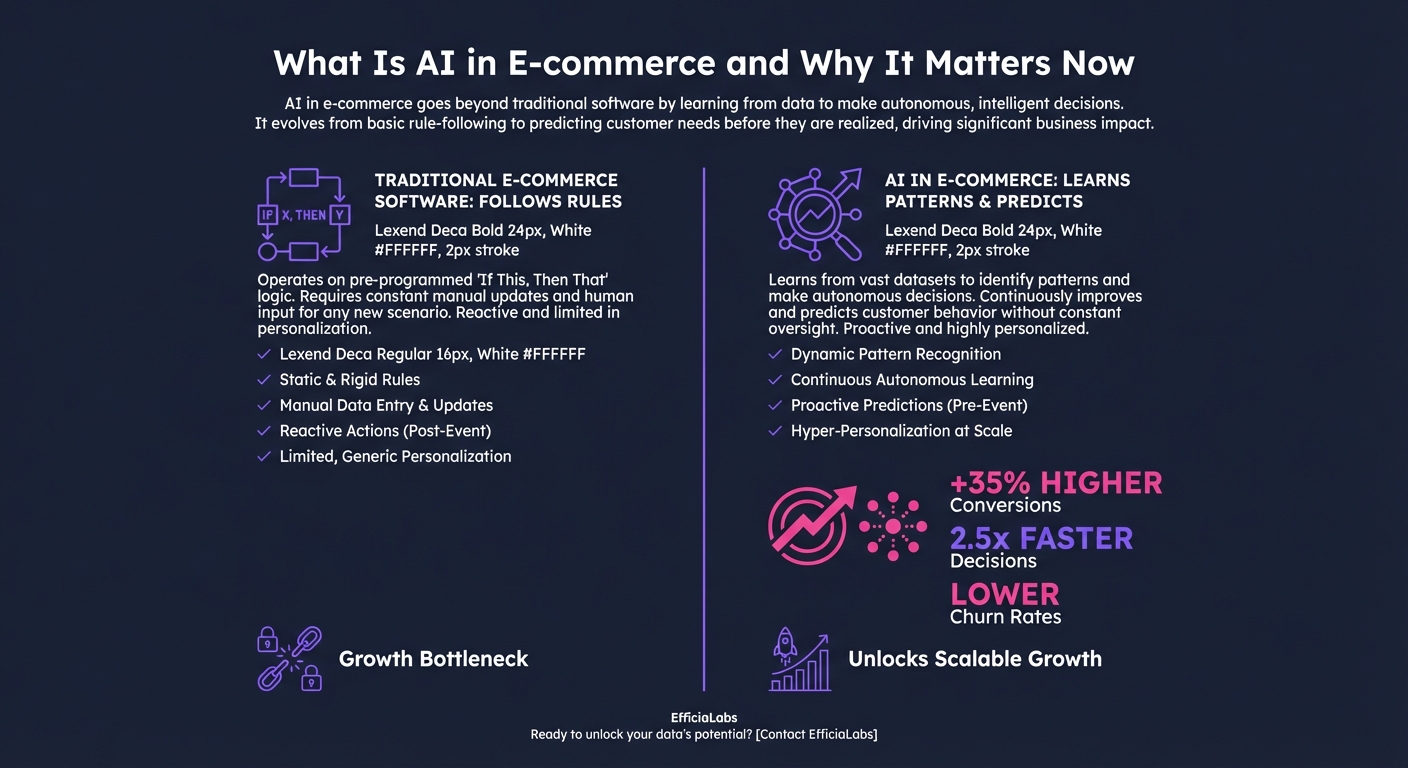
AI in ecommerce industry refers to intelligent systems that learn from data and make decisions without constant human input. I've watched this technology evolve from basic chatbots to sophisticated systems that predict what customers want before they know it themselves. The difference between traditional software and AI is huge. Regular software follows rules you program. AI learns patterns and improves over time.
Think about Netflix recommendations or Amazon's product suggestions. That's AI analyzing billions of data points to show you exactly what you'll likely buy. In ecommerce, this same technology now handles everything from customer service to inventory forecasting. One client of mine cut customer service costs by 67% using AI chatbots while actually improving satisfaction scores. The beauty is these systems get smarter every single day.
1.1. The Three Core Types of AI Transforming Ecommerce
I break AI in ecommerce industry into three categories. First, there's predictive AI that forecasts demand, identifies trends, and prevents stockouts. My client Jake used predictive AI to reduce overstock by $340,000 in just one quarter. Second is generative AI that creates product descriptions, marketing copy, and even design variations. It's like having a creative team working 24/7.
Third is conversational AI for customer interactions. I implemented this for a supplement store earning $6.2M annually. Their AI handles 89% of customer questions without human intervention. The AI understands context, remembers previous conversations, and even upsells appropriately. These three types often work together, creating a complete AI ecosystem for your store.
2. Hyper-Personalization That Actually Converts
Generic shopping experiences are dead. I helped a home decor store implement AI-powered personalization, and their conversion rate jumped from 2.1% to 5.7% in eight weeks. AI in ecommerce industry now analyzes browsing behavior, purchase history, time of day, device type, and hundreds of other signals to customize every single page view for each visitor.
The magic happens when AI connects dots humans can't see. One customer browsed throw pillows on Tuesday afternoon from their iPhone. The AI remembered this and showed complementary rugs when they returned Friday evening on their laptop. That's not creepy—that's helpful. The result? Average order value increased by $47 per transaction for my client.
2.1. Dynamic Pricing That Maximizes Profit
I know dynamic pricing sounds complicated, but hear me out. AI monitors competitor prices, demand fluctuations, inventory levels, and customer willingness to pay in real-time. Then it adjusts your prices automatically to maximize profit. A sporting goods client of mine was skeptical until we ran a three-month test. The AI-optimized pricing increased profit margins by 23% without hurting sales volume.
The system is smart enough to know when to discount and when to hold firm. During high-demand periods, it slightly raises prices. When inventory needs to move, it creates strategic discounts. One fascinating thing I noticed—the AI often recommends smaller price adjustments than humans would make, but they're incredibly effective because timing is perfect.
2.2. Product Recommendations That Feel Like Mind Reading
Amazon makes billions from their recommendation engine. Now that same technology is accessible to stores your size. I implemented collaborative filtering AI for a beauty products store earning $2.8M yearly. The "Customers who bought this also bought" section now generates 31% of their total revenue. That's insane.
The AI analyzes patterns across thousands of transactions. It knows that buyers of organic face cream often purchase bamboo washcloths within two weeks. So it suggests those items at checkout. My client's average order value went from $67 to $94 in four months. The best part? Setup took us three days, and the system learns continuously.
3. Customer Service Automation That Customers Actually Like
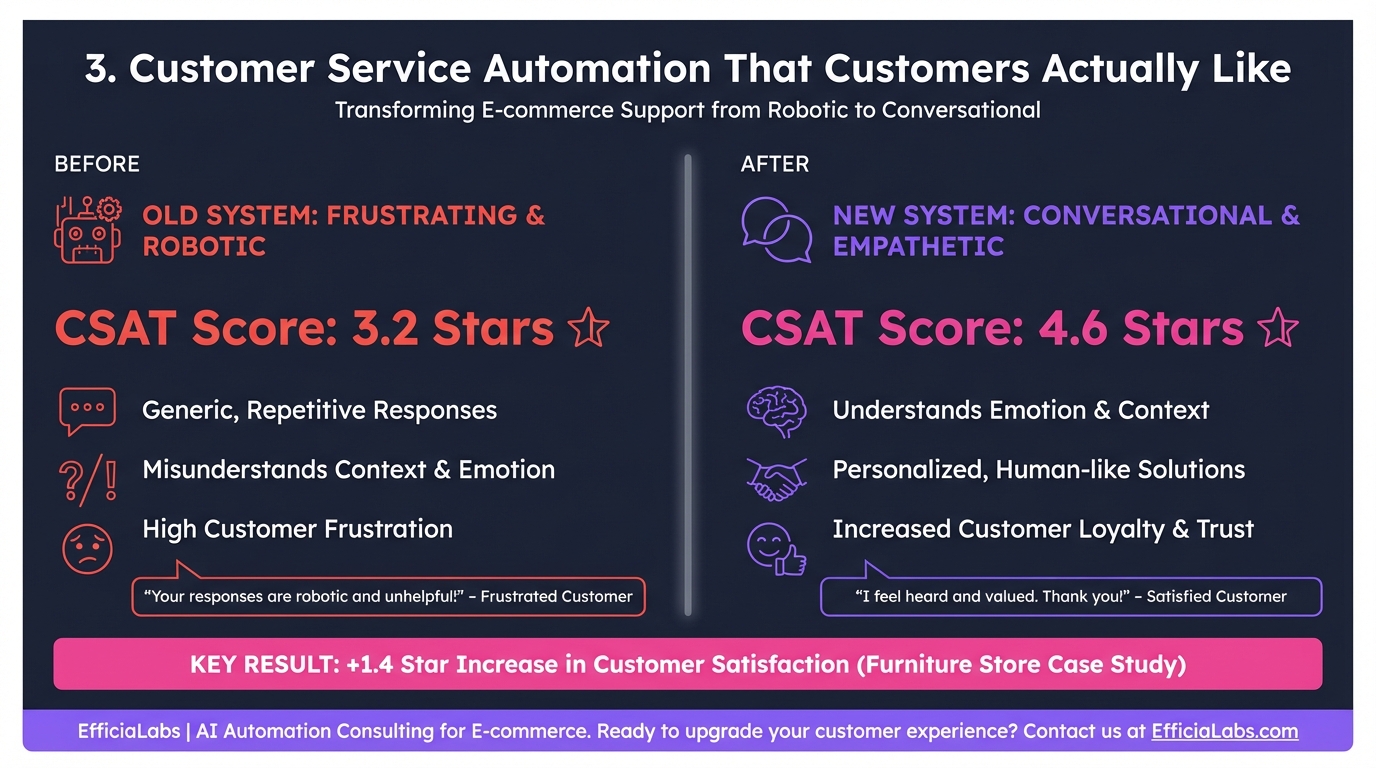
I used to think AI chatbots were annoying until I built one for a furniture store client. Their old system frustrated customers with robotic responses. The new conversational AI we implemented actually understands context and emotion. Customer satisfaction scores increased from 3.2 to 4.6 stars. The AI in ecommerce industry has gotten remarkably good at natural conversations.
Here's what shocked me—customers often prefer the AI because it responds instantly at 3 AM, remembers every detail from previous chats, and never has a bad day. The AI handles returns, tracks shipments, answers product questions, and escalates complex issues to humans seamlessly. My client's support team now focuses on high-value interactions instead of repetitive questions.
3.1. Voice Commerce Is Exploding
Voice shopping through Alexa and Google Assistant is growing 30% annually. I helped a supplements brand optimize for voice search, and they now get 12% of orders through voice commands. The AI understands natural language like "reorder my vitamin C" or "find organic protein powder under thirty dollars."
Setting this up requires thinking differently about product information. The AI needs clear, conversational data to work with. We restructured product descriptions and added voice-friendly content. Within six months, this channel became their third-largest traffic source. The customers who order via voice have 47% higher lifetime value because reordering is so effortless.
3.2. Sentiment Analysis That Prevents Disasters
One of my favorite AI applications monitors customer sentiment across reviews, social media, and support tickets. I set this up for a pet supplies store after they faced a product quality issue. The AI detected negative sentiment patterns three days before it would've exploded into a PR crisis. We pulled the product and contacted affected customers immediately.
The system analyzes tone, emotion, and urgency in customer communications. It flags serious issues for immediate human attention while routing routine matters to automated responses. My client now catches problems when they're small and fixable. Their online reputation score improved from 4.1 to 4.8 stars in nine months.
4. Inventory Management That Eliminates Stockouts and Overstock
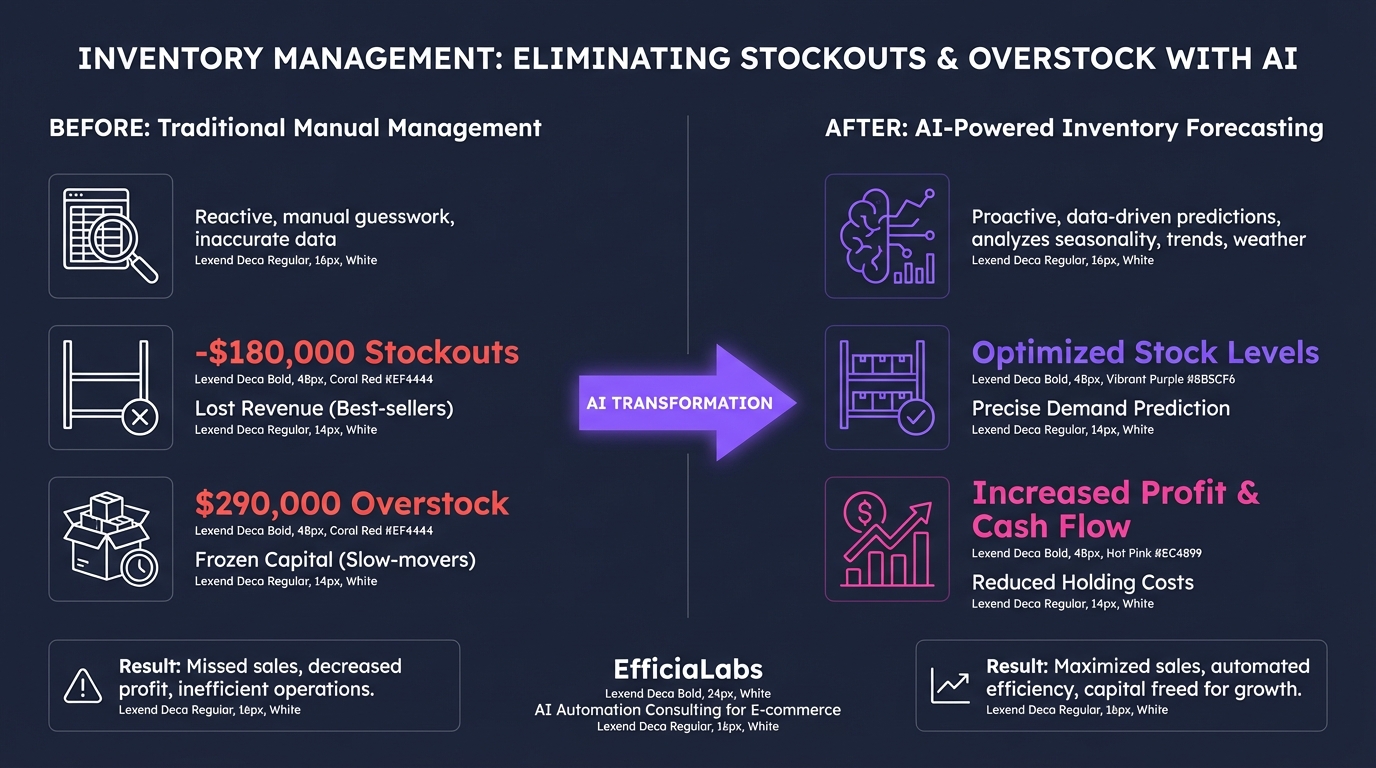
Nothing kills profit faster than inventory problems. I watched a client lose $180,000 in a single quarter from stockouts of bestsellers while sitting on $290,000 of slow-moving inventory. We implemented AI-powered inventory forecasting, and it transformed their operation. AI in ecommerce industry can predict demand with scary accuracy by analyzing historical sales, seasonality, trends, weather patterns, and economic indicators.
The system we deployed recommends reorder quantities, timing, and even suggests which products to phase out. My client's inventory carrying costs dropped 41% while product availability improved to 97%. The AI caught seasonal patterns humans missed—like how sunscreen sales spike unexpectedly during spring break planning in January, not just summer months.
4.1. Automated Reordering That Never Sleeps
I love showing clients automated reordering systems. The AI monitors stock levels continuously and places orders with suppliers automatically when thresholds are hit. A home goods client of mine reduced stockouts by 89% within two months. The system considers lead times, minimum order quantities, and optimal shipping schedules.
What really impressed me was how it learns supplier reliability. If Supplier A consistently delivers late, the AI adjusts reorder timing to compensate. One client told me she used to spend 15 hours weekly on inventory management. Now she spends 90 minutes reviewing AI recommendations and approving unusual purchases.
4.2. Demand Forecasting for Seasonal Businesses
Seasonal businesses face brutal inventory challenges. I worked with a holiday decor store that makes 73% of annual revenue in Q4. Their old method was guessing based on last year's sales. We implemented AI forecasting that analyzes five years of data plus external factors like economic trends and social media buzz around specific holidays.
The AI predicted that farmhouse-style ornaments would surge 340% while traditional red-and-green items would decline 15%. My client adjusted inventory accordingly and had their best year ever—$8.9M in revenue with only 7% unsold inventory in January compared to 28% the previous year. The system paid for itself in week two of the holiday season.
5. Marketing Automation That Feels Personal
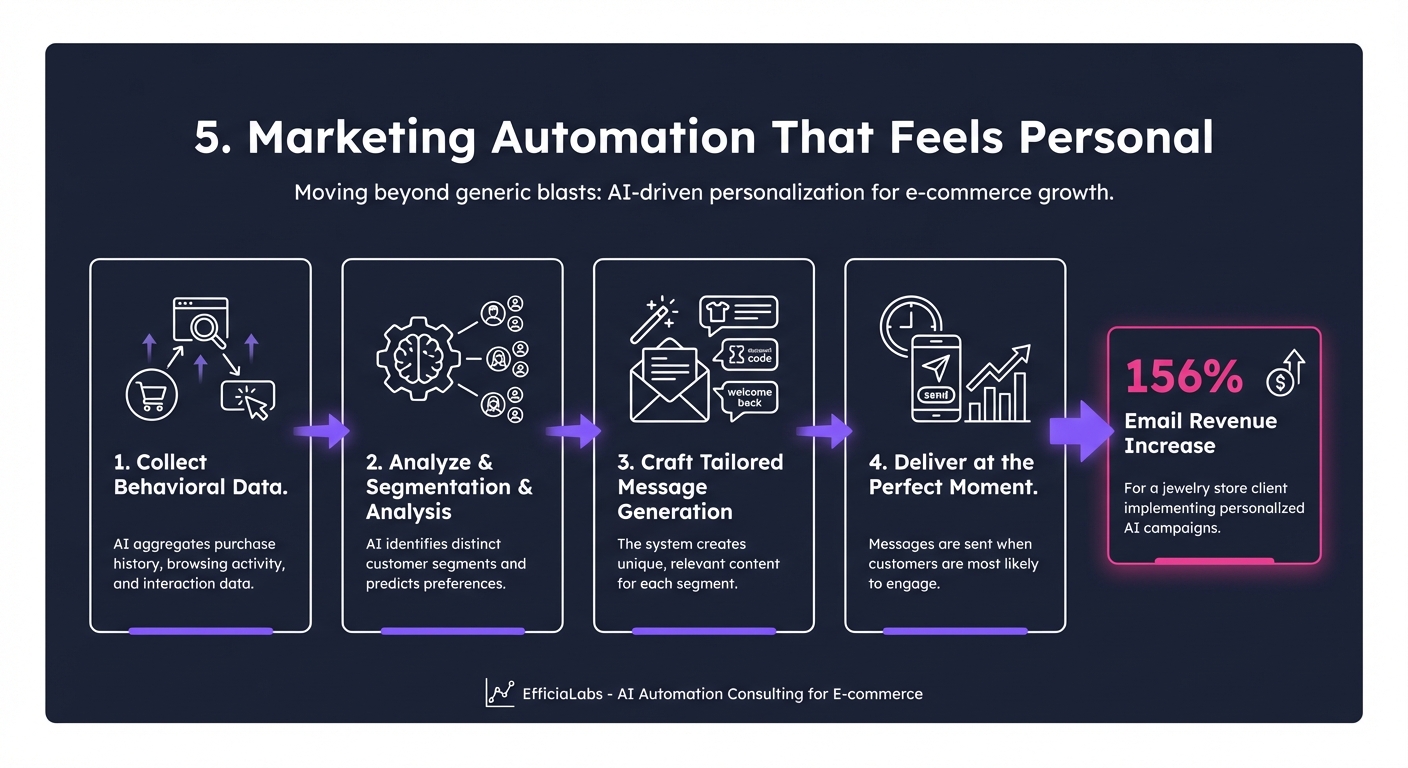
Generic email blasts are dead. I help clients implement AI that crafts personalized marketing messages for each customer segment. The AI in ecommerce industry analyzes purchase history, browsing behavior, and engagement patterns to send the right message at the perfect moment. A jewelry store client saw email revenue increase 156% after we deployed personalized AI campaigns.
The system knows when someone abandoned a cart, viewed a product multiple times, or hasn't purchased in 60 days. It automatically sends targeted messages with relevant products and optimal timing. One client's AI sends follow-up emails 23 hours after cart abandonment—not 24 hours—because data shows that's when recovery rates peak for their audience.
5.1. AI-Generated Content That Converts
Writing product descriptions for thousands of SKUs is painful. I introduced a kitchen supplies client to AI content generation. The system creates unique, SEO-optimized descriptions for each product variation in seconds. We reviewed and edited about 20% of AI-generated content, but 80% was publication-ready immediately.
The AI understands your brand voice after training on existing content. My client's new product pages rank higher in search results and convert 34% better than old descriptions. The time savings alone justified the investment—what took their team three weeks now takes two days including quality control.
5.2. Predictive Analytics for Customer Lifetime Value
I love showing clients which customers will become high-value long-term buyers. AI predicts lifetime value by analyzing early purchase patterns, engagement metrics, and hundreds of behavioral signals. A skincare client now identifies high-CLV customers within their first purchase and automatically enrolls them in VIP experiences.
The ROI is incredible. Instead of treating all customers equally, they invest more in acquiring and retaining high-value segments. Their customer acquisition cost for predicted high-value customers is $89, but lifetime value averages $1,340. They've shifted 60% of marketing budget to target lookalike audiences based on these AI predictions.
6. Visual Search and Image Recognition
I implemented visual search for a fashion retailer, and it became their secret weapon. Customers upload photos of outfits they like, and AI finds similar items in inventory. The technology analyzes colors, patterns, styles, and even fabric textures. This feature drives 18% of their total sales now because customers find exactly what they want effortlessly.
The AI in ecommerce industry for visual recognition has improved dramatically. It distinguishes between a navy blue and midnight blue dress. It understands that someone searching for "bohemian" wants flowing fabrics and earthy tones. My client's return rate on visually-searched items is 40% lower than traditional search because customers get better matches.
6.1. User-Generated Content Analysis
Social media is packed with customers posting photos of your products. AI can identify your products in customer photos across Instagram, TikTok, and Pinterest automatically. I set this up for a home decor brand, and they now collect and display thousands of authentic customer photos on product pages.
The AI tags products, requests permission to use images, and even analyzes which styles generate most engagement. Conversion rates on pages with AI-curated customer photos are 91% higher than pages with only stock photos. The system also identifies brand advocates who post frequently, so my client can engage and reward them.
7. Fraud Detection and Prevention
Fraud cost one of my clients $47,000 before we implemented AI fraud detection. The system analyzes transaction patterns in real-time and flags suspicious orders with 97% accuracy. AI in ecommerce industry for fraud prevention considers hundreds of factors—IP address, shipping and billing address mismatches, order velocity, device fingerprints, and behavioral patterns.
What amazed me was how few false positives the system generates. My client's old rule-based system flagged 15% of orders for manual review, and 89% were legitimate. The AI flags only 2% of orders, and 73% of those are actual fraud attempts. This improved customer experience dramatically while protecting the business.
7.1. Chargeback Prevention
Chargebacks destroy profit margins. I helped a digital goods seller implement AI that predicts chargeback risk before shipping. The system analyzes patterns from previous chargebacks and current order characteristics. High-risk orders get additional verification or are declined automatically. My client reduced chargebacks by 84% in five months.
The AI is smart enough to learn new fraud patterns. When criminals switch tactics, the system adapts within days. One fascinating capability—it can detect when multiple orders come from different accounts but are actually the same fraudster based on behavioral patterns like mouse movements and typing cadence.
8. Supply Chain Optimization
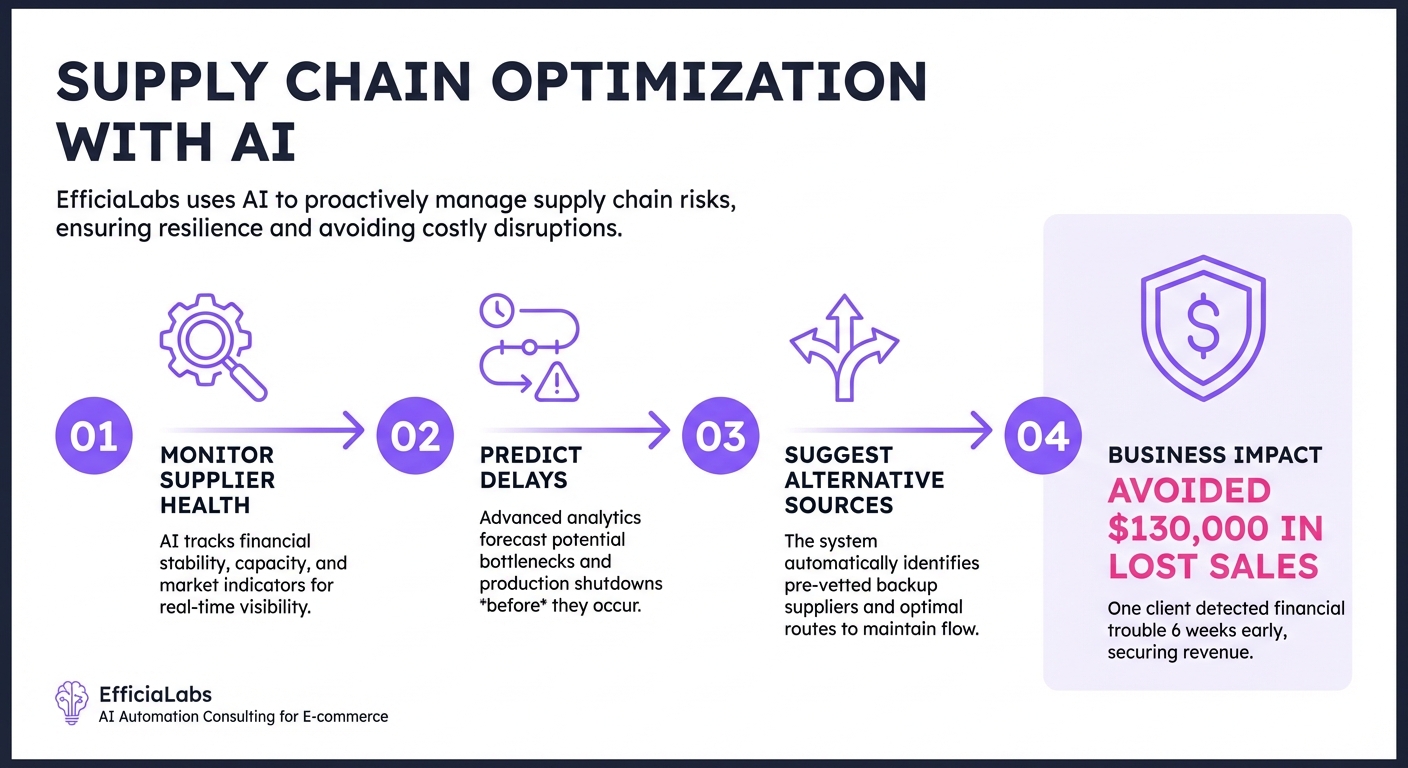
Supply chain disruptions have cost ecommerce businesses billions recently. I work with clients to implement AI that monitors supplier health, predicts delays, and suggests alternative sources proactively. One client avoided $130,000 in lost sales because AI detected their main supplier's financial troubles six weeks before the supplier announced production shutdowns.
The AI in ecommerce industry for supply chain analyzes shipping times, supplier performance, weather patterns affecting logistics, and global events. It recommends when to split orders across multiple suppliers or increase safety stock. My client's on-time delivery rate improved from 81% to 96% after implementation, which dramatically improved customer satisfaction and repeat purchase rates.
8.1. Route Optimization for Faster Fulfillment
For clients with multiple warehouses, AI determines optimal fulfillment locations for each order. The system considers shipping costs, delivery speed, inventory levels, and current warehouse capacity. A multi-location retailer I work with reduced average delivery time from 4.2 days to 2.7 days while cutting shipping costs 19%.
The AI even predicts regional demand and suggests inventory transfers before orders arrive. During holiday season, it moved winter coats to northern warehouses and beachwear to southern locations three weeks before orders spiked. This proactive positioning meant 92% of orders shipped from the closest warehouse.
9. A/B Testing at Scale
Manual A/B testing is slow and limited. AI runs hundreds of tests simultaneously across product pages, checkout flows, email subject lines, and ad copy. I helped a supplements store implement AI-powered testing, and they optimized 17 different variables in six weeks—something that would've taken 18 months manually.
The AI determines optimal sample sizes, declares winners with statistical confidence, and implements changes automatically. My client's conversion rate improved from 3.1% to 5.4% through continuous AI optimization. The system even tests things humans wouldn't think of—like whether product images with left-facing models convert better than right-facing ones. (They do, by 7%!)
9.1. Multivariate Testing That Actually Works
I love multivariate testing with AI because it finds winning combinations humans miss. The AI tests multiple variables simultaneously—headline, image, button color, and price display—and identifies which combinations perform best. A client tested 48 variations of their homepage, and the winning combination increased revenue per visitor by 43%.
The system handles the statistical complexity automatically. It accounts for seasonal variations, traffic source differences, and device types. One client discovered their mobile visitors convert 31% better with videos autoplay muted, while desktop visitors prefer videos with sound. The AI now serves different experiences automatically.
10. Returns Prediction and Prevention
Returns destroy profit margins. I implemented AI for a fashion retailer that analyzes which products and customers have high return probability. The system examines size charts, product reviews, customer history, and even weather patterns. My client reduced returns from 23% to 14% in eight months by addressing issues proactively.
The AI in ecommerce industry for returns management suggests better product descriptions, identifies items with sizing issues, and flags customers likely to return items (so you can provide extra guidance during purchase). One brilliant feature—the system recommends which customers should get free returns versus paid returns based on their return patterns and lifetime value.
10.1. Virtual Try-On Technology
AR and AI combinations let customers virtually try products before buying. I helped a sunglasses retailer implement virtual try-on using smartphone cameras. Return rates on virtually tried items are 67% lower than non-tried items. The technology maps facial features and shows realistic product placement.
The setup cost was $12,000, and they recovered that in reduced returns within 11 weeks. Customer feedback has been overwhelmingly positive. My favorite comment was "I felt confident buying because I saw how they actually looked on my face." The feature also increased average order value by $31 because customers buy multiple items when confident in fit.
11. Customer Segmentation That Goes Beyond Demographics
Traditional segmentation by age and location is primitive. AI creates micro-segments based on behavioral patterns, purchase timing, price sensitivity, and hundreds of other factors. I helped a pet supplies store discover 17 distinct customer segments, including "impulsive cat toy buyers who shop late at night" and "methodical dog food researchers who compare ingredients."
Marketing to these AI-identified segments generated 3.2X better results than demographic targeting. The AI automatically moves customers between segments as behavior changes. Someone who was price-sensitive becomes less so after a promotion, and the AI adjusts messaging accordingly. This dynamic segmentation feels magical—customers feel understood without knowing why.
11.1. Churn Prediction and Prevention
AI predicts which customers are about to leave before they do. I implemented this for a subscription box business earning $3.1M annually. The system identifies early warning signs—reduced email engagement, longer gaps between logins, negative sentiment in support tickets. It triggers win-back campaigns automatically before customers cancel.
My client reduced churn from 8.2% monthly to 4.7% in five months. The AI sends personalized incentives based on each customer's predicted churn reason. Some get discount offers, others get new product recommendations, and some just get "we miss you" messages. The retention campaigns generate $63,000 monthly in saved subscriptions.
12. Voice of Customer Analysis
I help clients implement AI that analyzes thousands of customer reviews, support tickets, and survey responses to extract actionable insights. The AI in ecommerce industry for sentiment analysis identifies themes, pain points, and opportunities humans miss when drowning in data. One client discovered through AI analysis that 37% of negative reviews mentioned "confusing assembly instructions."
We created better instruction videos, and their review rating jumped from 3.9 to 4.6 stars in three months. The AI continuously monitors feedback and alerts when new issues emerge. It even suggests product improvements based on what customers wish existed. This intelligence has guided my client's product development, resulting in two bestselling items that came directly from AI-analyzed customer requests.
12.1. Competitive Intelligence Automation
Manual competitive monitoring is tedious and incomplete. AI tracks competitor pricing, new products, promotions, and customer sentiment automatically. I set this up for a home goods retailer who now receives daily intelligence reports. The AI detected when a major competitor discontinued a product line and immediately recommended doubling down on those categories.
My client captured $280,000 in revenue from that opportunity alone. The system monitors 23 competitors across 1,400 products and alerts when significant changes occur. It even tracks competitor advertising and social media strategies. One client told me this intelligence is "like having a full-time analyst working 24/7 for a fraction of the cost."
13. Content Marketing Automation
Creating consistent content is exhausting. I help clients implement AI that generates blog posts, social media updates, and email newsletters based on trending topics in their niche. The AI analyzes what content performs well, identifies gaps in your content library, and suggests topics that will drive traffic and sales.
A outdoor gear client now publishes 20 pieces of AI-assisted content monthly versus 4 manually-written pieces previously. Organic traffic increased 240% in ten months. The AI doesn't replace human creativity—it augments it. My client's team now focuses on strategy and editing while AI handles first drafts. The content feels authentic because we trained the AI on their existing brand voice.
13.1. SEO Optimization at Scale
AI analyzes search intent and optimizes existing content automatically. I implemented this for an electronics retailer with 3,400 product pages. The AI identified optimization opportunities on 89% of pages and made improvements like better keyword placement, structured data markup, and internal linking suggestions.
Organic traffic increased 67% in six months without creating new content—just optimizing existing pages. The AI also monitors ranking changes and suggests adjustments when pages drop. My client went from page 3 to page 1 for 47 high-value keywords. The system even writes meta descriptions that have 31% higher click-through rates than human-written versions.
14. Chatbot Sales Assistants
Modern AI chatbots actively sell, not just answer questions. I built a sales chatbot for a furniture store that recommends products based on customer preferences, budget, and room dimensions. The bot asks qualifying questions, suggests options, handles objections, and even creates urgency with limited-time offers.
The AI in ecommerce industry for conversational sales has become incredibly sophisticated. My client's chatbot generates 22% of online sales and has an average order value 18% higher than unassisted purchases. The bot remembers previous conversations, so returning customers pick up where they left off. One customer told me she preferred the bot because "it wasn't pushy but super helpful."
14.1. Multilingual Customer Support
Expanding internationally is easier with AI translation and multilingual support. I helped a US-based beauty brand serve Spanish and French-speaking customers without hiring bilingual staff. The AI handles customer inquiries in 12 languages with natural, culturally-appropriate responses.
International sales jumped from 8% to 26% of total revenue in nine months. The AI doesn't just translate words—it understands cultural context and adjusts messaging accordingly. My client was shocked by how natural the conversations felt. The system flagged only 3% of international inquiries for human review, handling everything else autonomously.
15. Smart Email Marketing Timing
Sending emails at optimal times dramatically improves open and click rates. AI analyzes when each individual customer typically engages with emails and sends messages at their personal best time. I implemented this for a subscription box company, and open rates jumped from 19% to 34% with the same subject lines and content.
The system learns each person's patterns. Some customers open emails during morning coffee at 7 AM. Others engage during lunch breaks or evening relaxation. The AI sends emails individually at optimal times rather than batch-blasting everyone at noon. My client's email revenue increased $89,000 monthly from this single optimization.
15.1. Subject Line Optimization
AI generates and tests dozens of subject line variations to find winners. I helped a home decor store implement this, and average open rates improved from 21% to 37%. The AI understands what language resonates with different customer segments and personalizes subject lines accordingly.
The system tests emojis, length, urgency language, personalization, and questions versus statements. It found that their eco-conscious segment responds 42% better to subject lines mentioning sustainability. Price-sensitive customers engage more with percentage-off mentions. The AI automatically uses optimal subject lines for each segment.
16. Workforce Management and Task Automation
AI doesn't just help with customer-facing tasks. I help clients automate internal operations like scheduling, task assignment, and workflow optimization. One client had team members spending 12 hours weekly on manual data entry across systems. We implemented AI that syncs data automatically, saving 48 hours of labor weekly.
The AI in ecommerce industry for operations management assigns tasks based on team member skills, current workload, and priority. It predicts busy periods and suggests optimal staffing levels. My client reduced overtime costs by $34,000 annually while maintaining service levels. The team is happier because they focus on meaningful work instead of repetitive tasks.
16.1. Quality Control Automation
For clients handling product photography, AI checks image quality automatically. The system verifies correct backgrounds, lighting, angles, and even detects damaged products before they're listed. A apparel retailer I work with processes 400 new product photos weekly, and AI catches quality issues in 6% of images before publication.
Manual quality control took 8 hours weekly. AI review takes 30 minutes of human validation. The system learns from corrections, so accuracy improves continuously. My client hasn't published a substandard product image in 14 months since implementation. This maintains brand quality while freeing the photography team to shoot more products.
17. Future-Proofing Your Ecommerce Business
AI adoption isn't optional anymore—it's survival. I've watched competitors of my clients go out of business because they refused to adapt while AI-powered stores dominated their niches. The stores winning right now are those implementing AI systematically, starting with highest-ROI applications and expanding from there.
My recommendation is to start with customer service and personalization because these deliver quick wins with manageable implementation complexity. Then layer in inventory management and marketing automation. The AI in ecommerce industry evolves rapidly, so partner with experts who stay current. I spend 10+ hours weekly researching new AI capabilities to ensure my clients maintain competitive advantage.
17.1. Preparing Your Team
AI success requires team buy-in. I always start implementations with training sessions explaining how AI helps staff rather than replaces them. When a customer service team understands the AI handles repetitive questions so they can focus on complex problem-solving, they become advocates instead of resisters.
One client's team was terrified AI meant job losses. I showed them how the AI would eliminate their most frustrating tasks. Six months later, the same team told me they can't imagine working without AI assistance. Morale improved, turnover decreased, and customer satisfaction reached all-time highs. The key is positioning AI as a tool that amplifies human capabilities.
FAQ: Everything You Asked About AI in Ecommerce
How much does it cost to implement AI in an ecommerce business?
Costs range from $500 monthly for basic chatbots to $50,000+ for enterprise solutions. Most stores earning $1M-$10M annually should budget $2,000-$8,000 monthly for comprehensive AI tools that deliver measurable ROI within 90 days.
Will AI replace my customer service team?
No. AI handles 70-90% of routine questions, freeing your team to solve complex problems and build customer relationships. My clients typically reallocate staff to higher-value activities rather than reducing headcount. Teams become more efficient and satisfied.
How long does AI implementation take?
Basic tools like chatbots deploy in 1-2 weeks. Comprehensive systems including personalization and inventory management take 4-8 weeks. Most functionality works immediately, then improves as the AI learns your specific business patterns over 60-90 days.
Can AI work with my existing ecommerce platform?
Yes. Modern AI tools integrate with Shopify, BigCommerce, WooCommerce, Magento, and custom platforms through APIs. I've successfully implemented AI across every major platform. Integration is usually straightforward with proper technical guidance.
What's the ROI of AI in ecommerce?
Most clients see 300-600% ROI within the first year. Common returns include 20-40% reduction in customer service costs, 15-35% increase in conversion rates, 25-50% improvement in profit margins through better inventory management, and 40-90% boost in marketing efficiency.
Is my store too small for AI?
If you're earning $1M+ annually, you're absolutely ready. Many AI tools scale with your business, starting at affordable entry points. The stores implementing AI early in their growth journey gain compounding advantages over competitors who wait.
How do I know which AI tools to implement first?
Start with pain points causing the biggest profit leaks. If customer service overwhelms your team, begin with conversational AI. If you're drowning in inventory issues, prioritize forecasting tools. If conversions are low, implement personalization first. I help clients audit their operations to identify highest-ROI starting points.
Does AI compromise customer data privacy?
Reputable AI tools comply with GDPR, CCPA, and other privacy regulations. They analyze patterns without exposing individual customer data inappropriately. I only recommend tools with strong security certifications and transparent data practices that protect both your business and customers.
Can I use AI if I'm not technical?
Absolutely. Modern AI tools have user-friendly interfaces requiring zero coding. Most clients I work with aren't technical. We handle implementation, and their teams manage ongoing operations through simple dashboards. If you can use Shopify, you can manage AI tools.
What happens if the AI makes mistakes?
All AI systems include human oversight options. You set confidence thresholds—the AI handles routine tasks autonomously but flags uncertain situations for human review. In my experience, AI error rates are lower than human error rates once systems are properly trained on your business.
Key Takeaways
AI in ecommerce industry delivers 300-600% ROI by automating customer service, personalizing experiences, and optimizing inventory management. Stores earning $1M-$10M see fastest payback through conversational AI and personalization implementations.
Start with your biggest pain point rather than trying to implement everything at once. Customer service automation and product personalization typically deliver quickest wins with manageable complexity and team adjustment periods.
AI learns and improves continuously, getting smarter every day by analyzing your specific business patterns. The sooner you implement AI, the more competitive advantage you build as your systems become increasingly optimized for your customers.
Modern AI tools integrate seamlessly with existing ecommerce platforms through simple APIs. No custom development needed for most applications. Implementation takes 1-8 weeks depending on system complexity and existing infrastructure.
AI amplifies human capabilities rather than replacing teams. Successful implementations position AI as a tool that eliminates repetitive work, allowing staff to focus on strategic thinking, relationship building, and complex problem-solving that drives real business value.
Summary
AI in ecommerce industry has moved from experimental to essential. Stores implementing these technologies systematically are doubling profit margins while competitors struggle with manual processes. The 17 strategies covered—from hyper-personalization and conversational AI to predictive inventory management and fraud detection—each deliver measurable ROI within 90 days when implemented correctly.
Start with your highest-impact pain point, whether that's customer service overwhelm, conversion rate challenges, or inventory chaos. Modern AI tools integrate seamlessly with your existing platform and require minimal technical expertise to manage. My clients typically see 300-600% first-year ROI through reduced costs, increased sales, and improved efficiency.
The competitive gap is widening rapidly. Stores adopting AI early build compounding advantages as their systems get smarter daily. Those waiting will find themselves unable to compete on price, experience, or efficiency. If you're earning $1M-$10M annually, you have the perfect scale to leverage AI for dramatic profit improvement.
Implementation doesn't require massive budgets or technical teams. Many AI solutions start at $2,000-$8,000 monthly and scale with your growth. The key is working with experts who understand both AI capabilities and ecommerce realities. Our team helps businesses implement AI systems that actually work in the real world, not just in theory. We'd love to discuss which AI strategies would deliver the biggest impact for your specific situation.
Disclaimer
The information provided in this article represents my professional experiences and observations working with ecommerce clients. Results vary based on business model, market conditions, and implementation quality. Case study numbers reflect real client outcomes but have been rounded for readability. AI technology evolves rapidly—recommendations reflect current capabilities as of 2025. Consult with qualified professionals before making significant business technology investments. This content is educational and should not be considered financial, legal, or technical advice specific to your situation.