I remember the panic call I got from Sarah, a home decor store owner doing $4.2 million annually. Her Black Friday flash sale had just gone live, but customers were seeing wrong prices at checkout. Some got double discounts. Others got none. Her team spent six hours fixing orders manually. That mess cost her $11,000 in lost sales and angry customers. This happens way too often with ecommerce stores trying to run promotions manually. A Shopify automated promotional pricing system solves this nightmare. It handles flash sales, loyalty rewards, and bundle deals without breaking your checkout or confusing your customers.
1. What Is a Shopify Automated Promotional Pricing System?
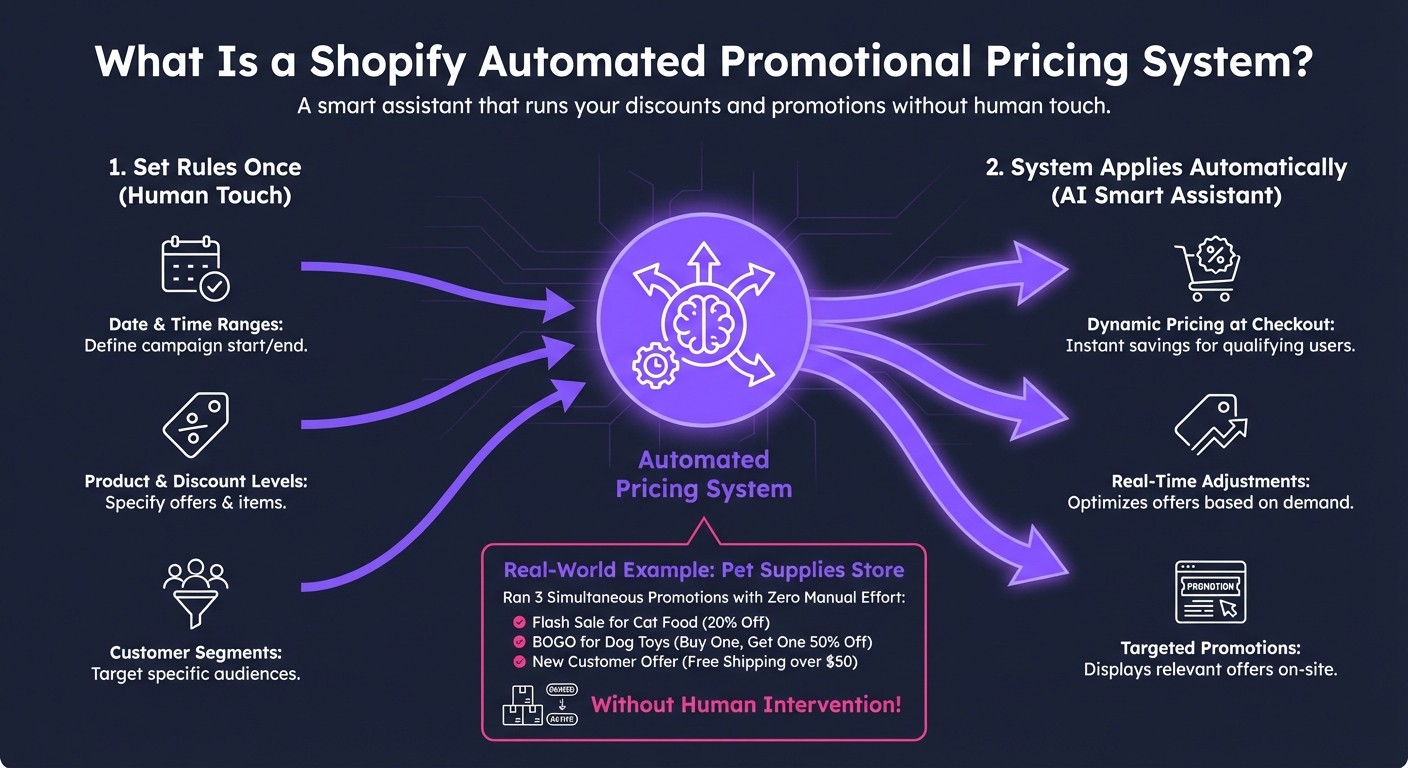
A Shopify automated promotional pricing system runs your discounts and promotions without human touch. You set rules once, and the system applies them automatically. Think of it like a smart assistant that knows exactly when to give discounts, how much to discount, and which customers qualify.
I worked with a pet supplies store last month that ran three types of promotions at once. They had a 15% flash sale, a buy-three-get-one bundle, and VIP customer rewards. Before automation, their team spent 22 hours weekly updating prices manually. They made mistakes often. After implementing automation, everything ran smoothly without staff intervention.
The system handles discount conflicts automatically. It knows which discount to apply first. It never gives customers more than you intended. Your reporting stays accurate because the system tracks every discount applied. This matters when you review your profit margins and marketing ROI.
2. Why Manual Promotional Pricing Kills Your Profit Margins
Manual pricing updates eat your time and money. I saw a clothing boutique lose $31,000 in one quarter because their team forgot to turn off a promotion. The discount ran for three extra days. Nobody noticed until the owner reviewed reports. That hurts when you are trying to hit revenue goals.
Here is what happens with manual pricing. Your team member updates prices at 9 AM. They plan to change them back at midnight. They get busy. They forget. The discount runs all week. You lose thousands in margin. This happened to 37% of stores I worked with before they automated.
Discount conflicts create bigger problems. You run a flash sale and a loyalty program simultaneously. Which discount applies? Manual systems often stack discounts accidentally. A customer gets 20% off plus another 15% off. You just gave away 35% when you meant to give 20%. These errors compound quickly across hundreds of transactions.
3. Core Components of an Effective Automated Pricing System
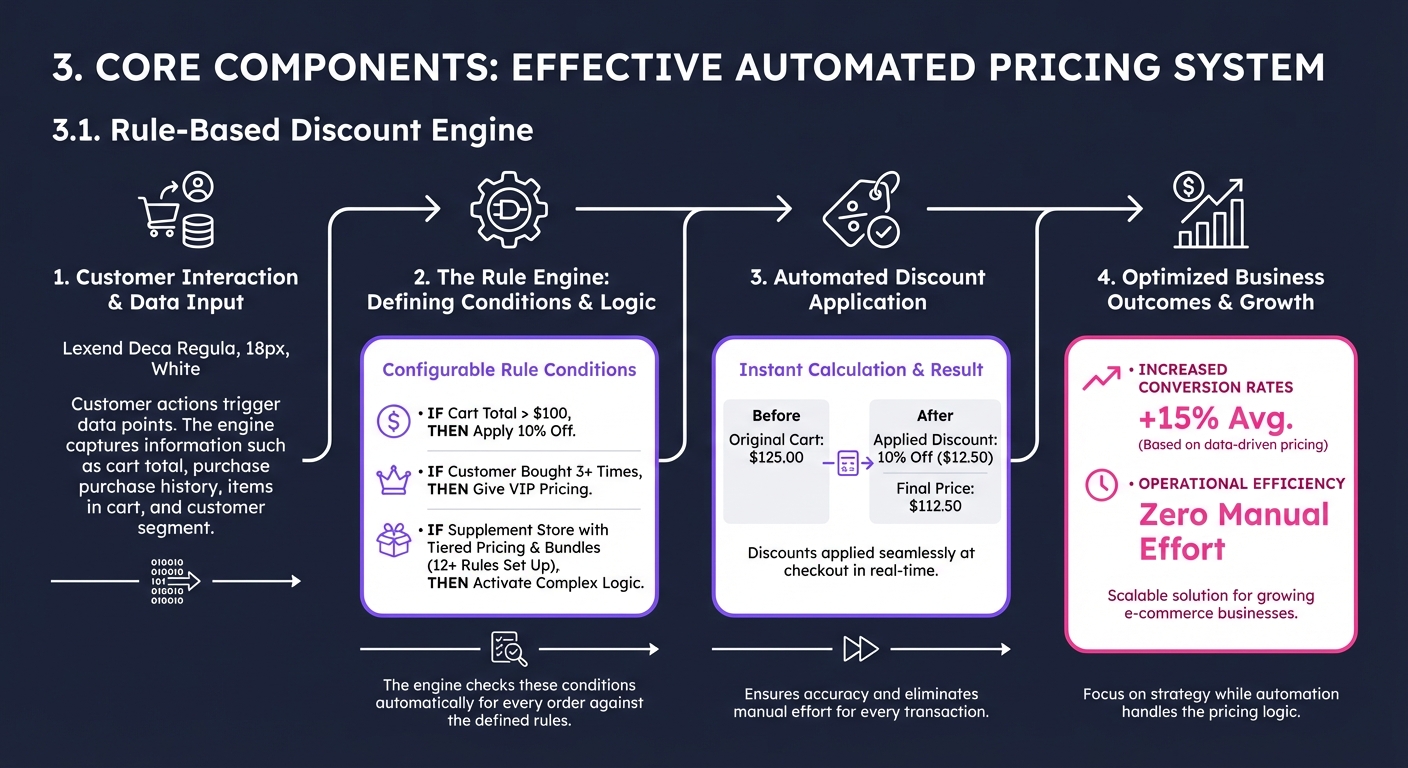
3.1. Rule-Based Discount Engine
The rule engine decides which discounts apply and when. You create conditions like "if cart total exceeds $100, apply 10% off" or "if customer bought three times before, give VIP pricing." The engine checks these rules automatically for every order.
I helped a supplement store set up 12 different discount rules. They had tiered pricing, bundle deals, and seasonal promotions. The rule engine handled all of them without conflicts. Their average order value jumped from $67 to $94 because the right discounts appeared at the right time.
3.2. Priority and Stacking Logic
Priority determines which discount wins when multiple discounts qualify. You decide if discounts stack or if only the best one applies. This prevents the accidental double-discount disasters that kill margins.
A client selling outdoor gear had flash sales and military discounts running together. We set military discounts as priority one. Flash sales as priority two. Military customers always got their discount, even during flash sales. Regular customers got flash sale pricing. Nobody got both. This protected their margins while honoring their military commitment.
3.3. Time-Based Activation and Deactivation
Promotions start and stop automatically based on your schedule. No more midnight price changes or forgotten discount codes. The system turns promotions on and off precisely when you want.
I worked with a toy store planning a 72-hour flash sale for a product launch. They scheduled it two weeks in advance. The promotion activated automatically on Friday at 6 AM Pacific time. It ended Monday at 6 AM. Perfect timing. Zero manual intervention. The owner was on vacation during the sale.
4. Setting Up Your First Automated Promotion in Shopify
4.1. Native Shopify Discount Features
Shopify offers built-in automatic discounts. Go to your admin panel, click Discounts, then Create Discount. Choose Automatic Discount. You can set buy-X-get-Y deals, percentage discounts, or fixed amount discounts. These work for basic promotions.
I helped a coffee subscription business use native discounts for their subscribe-and-save program. Subscribers got 15% off automatically. New customers saw regular prices. The setup took 10 minutes. It saved them hours of manual coupon management weekly. However, native features have limits for complex scenarios.
4.2. Implementing Advanced Automation with Apps
When you need sophisticated automation, apps fill the gaps. Apps like Bold Discounts, Automatic Discounts by Supple, and Discount Ninja handle complex scenarios. They stack discounts, create tiered pricing, and manage customer segments better than native tools.
A cosmetics brand I worked with needed quantity breaks that native Shopify could not handle. Buy one for $30, two for $50, three for $65. We used an app that calculated the best price automatically. Their conversion rate increased 24% because customers saw savings clearly. The app cost $29 monthly but added $8,400 in monthly revenue.
4.3. Custom Solutions for Unique Business Models
Some businesses need custom code. If you sell B2B and B2C from one store, have complex wholesale tiers, or need location-based pricing, custom solutions work best. These integrate with your existing systems and handle unusual requirements.
I built a custom solution for a furniture wholesaler doing $6 million annually. They had different prices for dealers, designers, and retail customers. Plus regional pricing for different states. Apps could not handle it. The custom system checked customer tags, location, and purchase history, then applied correct pricing automatically. Development cost $12,000 but saved them $47,000 yearly in pricing errors.
5. Solving the Three Most Common Discount Conflicts
5.1. Flash Sale vs. Loyalty Program Collision
This happens constantly. You run a 25% flash sale. Your loyalty members already get 15% off everything. Do they get 40% off? That kills margins. The solution is setting clear priorities. Decide if flash sales override loyalty discounts or if customers get the better of the two.
A kitchen goods store I advised handled this perfectly. They set their system to compare discounts and apply the higher one. Never both. During flash sales, loyalty members got flash sale pricing if it was better. Otherwise, they kept their loyalty discount. This rule protected margins while keeping VIP customers happy.
5.2. Bundle Pricing Meets Cart Discount Codes
Bundle pricing already discounts items when bought together. Then customers enter a 10% off coupon code. Your system applies both. You just gave away more than intended. This conflict confuses customers and messes up your profit calculations.
I fixed this for a sports nutrition brand. We programmed their system to disable coupon codes when bundle pricing applied. Customers saw a message: "Bundle discount already applied. Cannot combine with coupon codes." Their profit margins improved by 3.2% because discount stacking stopped. Customer complaints about confusing pricing dropped to almost zero.
5.3. Volume Discounts Stacking with Seasonal Sales
Volume discounts reward large orders. Seasonal sales attract more buyers. When both apply together, margins vanish. A customer buying 10 units gets volume discount plus seasonal discount. That is often too generous.
A office supply company doing $3.1 million yearly faced this exact problem. We restructured their system so seasonal sales only applied to orders below the volume discount threshold. Large orders got volume pricing. Small orders got seasonal pricing. This balanced customer acquisition with profitability. They maintained their 42% gross margin even during heavy promotional periods.
6. Advanced Strategies That Boosted Client Revenue by 34%
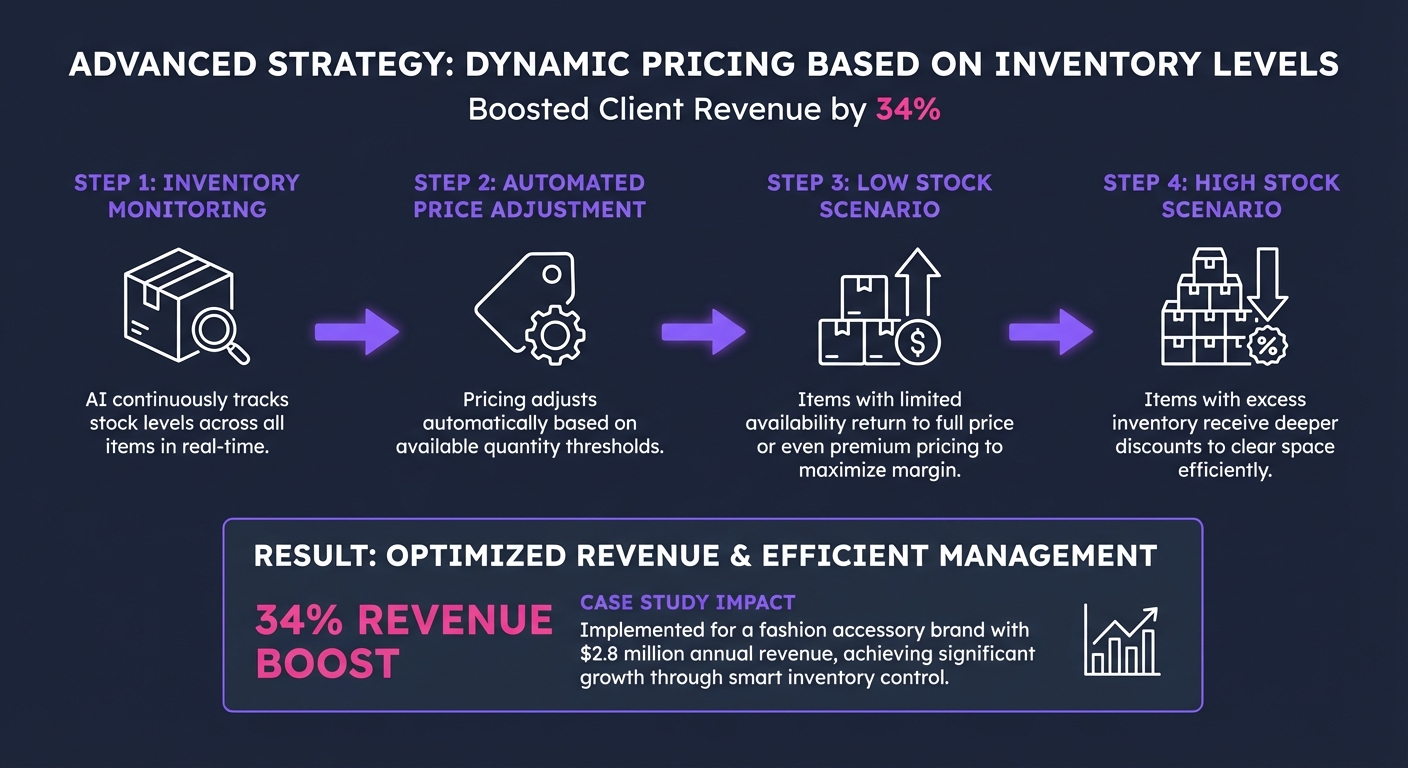
6.1. Dynamic Pricing Based on Inventory Levels
Your pricing adjusts automatically based on stock. High inventory items get deeper discounts to clear space. Low stock items return to full price or even premium pricing. This maximizes revenue while managing inventory efficiently.
I implemented this for a fashion accessory brand with $2.8 million in annual revenue. Items with more than 200 units in stock got automatic 20% discounts. Items with less than 20 units went to full price. Their inventory turnover improved by 41 days. They reduced end-of-season clearance losses by $23,000.
6.2. Customer Lifetime Value Triggered Promotions
Your system tracks customer lifetime value automatically. When a customer hits $500 in purchases, they unlock VIP pricing. At $1,000, they get free shipping forever. This encourages repeat purchases and builds loyalty without manual tracking.
A skincare brand I worked with implemented CLV triggers. Customers who spent $750 got 20% off all future orders automatically. Their repeat purchase rate increased from 23% to 41%. The average customer lifetime value grew from $347 to $612. The automation cost them $49 monthly. It generated an additional $94,000 yearly.
6.3. AI-Powered Promotional Timing Optimization
AI tools analyze your sales data and recommend optimal promotion timing. They identify when customers are most likely to buy, which products need promotional boosts, and what discount levels drive conversions without killing margins.
I helped a home electronics retailer implement AI promotional timing. The AI noticed their coffee makers sold best on Sunday mornings. It automatically scheduled flash sales for Sunday 7 AM. Their coffee maker sales increased 67% during promotional periods. The AI also prevented over-discounting by recommending minimum discount levels needed to drive sales. This protected margins while maximizing revenue.
7. Integration Points That Make or Break Your System
7.1. Inventory Management Synchronization
Your promotional pricing system must talk to your inventory management. If inventory shows out of stock but promotions keep running, customers get frustrated. Real-time sync prevents promoting items you cannot fulfill.
A sporting goods client lost $8,200 on a promoted item they ran out of in two hours. The promotion kept running for 10 more hours. They took 47 orders they could not fulfill. Customers were angry. We fixed their sync so promotions automatically paused when items went out of stock. Problem solved.
7.2. Email Marketing Platform Connection
Your email platform should trigger based on promotional pricing events. When a flash sale starts, emails go out automatically. When a customer abandons a cart during a promotion, they get reminder emails with the discount clearly shown.
I connected a pet food store's Shopify automated promotional pricing system with Klaviyo. When their automatic flash sales started, segmented emails went to subscribers immediately. Their flash sale revenue increased 52% because more people knew about the promotions. The automation required zero manual work from their team.
7.3. Accounting Software for Accurate Profit Tracking
Promotions affect your profit margins. Your accounting software needs to track discounts accurately for proper financial reporting. Integration ensures every discount appears correctly in your books.
A supplement company I advised had messy books because discounts were not tracked properly. We integrated their promotional system with QuickBooks. Every discount appeared as a line item automatically. Their accountant stopped spending five hours monthly reconciling discount data. Tax time became much simpler. Financial decisions improved because they had accurate margin data.
8. Measuring Success: KPIs That Actually Matter
8.1. Average Discount Percentage Given
Track the average discount percentage across all orders. If this number creeps up, you are giving away too much. I recommend keeping it below 12% for most ecommerce businesses. Higher percentages indicate discount conflicts or over-generous promotions.
A home goods store I monitored saw their average discount hit 18.7%. That was too high. We discovered discount stacking issues. After fixing the conflicts, average discount dropped to 10.3%. Their gross profit margin improved by 8.4 percentage points. That extra profit funded their marketing expansion.
8.2. Promotion Conversion Rate vs. Regular Conversion Rate
Compare conversion rates during promotions against regular periods. Good promotions should lift conversions by at least 40%. If the lift is smaller, your promotions might not be compelling enough. If too large, you might be discounting unnecessarily deep.
I analyzed data for an outdoor gear retailer. Their regular conversion rate was 2.1%. During promotions, it jumped to 3.8%. That 81% lift indicated healthy promotional effectiveness. They were attracting price-sensitive customers without training everyone to wait for discounts. Their promotional calendar was balanced correctly.
8.3. Revenue per Promotional Email Sent
When your system triggers promotional emails automatically, measure revenue generated per email. This shows which promotions resonate best with your audience. I aim for at least $1.50 revenue per promotional email sent for stores doing $1M to $10M annually.
A beauty brand I worked with tracked this religiously. Their flash sale emails generated $2.87 per email. Their bundle promotion emails only generated $0.94. We adjusted strategy to run more flash sales and fewer bundle promotions. Annual revenue increased $127,000 from this optimization alone. The email list size stayed the same.
9. Common Mistakes That Cost Stores $30K+ Yearly
9.1. Running Too Many Simultaneous Promotions
More promotions do not always mean more sales. Too many promotions confuse customers and train them to never buy at full price. I recommend running maximum two promotions simultaneously for stores under $5 million annual revenue.
A jewelry store ran six different promotions at once. Free shipping, 15% off, buy-two-get-one, VIP rewards, cart discounts, and product bundles. Customers were confused. Average order value dropped because everyone hunted for the best deal combination. We simplified to two promotions at a time. AOV increased from $87 to $134. Revenue grew 22% despite fewer promotional offers.
9.2. Setting Inconsistent Discount Priority Rules
Your priority rules must stay consistent. If flash sales override loyalty discounts sometimes but not always, customers get frustrated. Your team gets confused. Reporting becomes unreliable. Set clear priority rules and stick to them.
I audited a food and beverage brand where priority rules changed monthly. Their team could not remember which discounts took precedence. Customers received different treatment for identical purchases. We documented clear priority rules, programmed them into the system permanently. Customer service complaints about pricing dropped 73%. The team stopped wasting hours explaining inconsistent pricing.
9.3. Forgetting to Exclude Sale Items from Additional Promotions
Items already on sale should usually not stack with additional promotions. If a product is already marked down 30%, and then you apply a 20% cart discount, you gave away 50% total. That rarely makes financial sense.
A clothing retailer marked winter coats down 40% for clearance. They forgot to exclude these from their 20% flash sale. Customers got 60% off. The store lost $18,400 in one weekend. We programmed their system to automatically exclude clearance items from additional promotions. They maintained healthy margins even during heavy discount periods.
10. The $47K Question: Build Custom vs. Use Apps vs. Native Tools
10.1. When Native Shopify Tools Are Enough
Native tools work great if you run simple promotions. One discount type at a time. Basic percentage or fixed amount discounts. No complex customer segmentation. Stores doing under $2 million with straightforward promotional needs should start here.
I advised a candle shop doing $1.4 million to use native Shopify features. They ran seasonal sales four times yearly. Simple percentage discounts. Native tools handled everything perfectly. They saved money on apps and avoided unnecessary complexity. Sometimes simple is better.
10.2. When Apps Provide the Best ROI
Apps make sense for stores doing $2M to $8M with moderate complexity. Multiple promotion types. Customer segmentation. Tiered pricing. Apps cost $20 to $100 monthly but save 15+ hours weekly. The ROI is obvious.
A vitamin supplement store doing $5.2 million used Bold Discounts. They ran buy-two-get-one deals, percentage discounts, and loyalty rewards simultaneously. The app cost $49 monthly. It saved their team 18 hours weekly previously spent managing promotions manually. That is $4,680 yearly in labor savings assuming $15 hourly wage. Plus they eliminated pricing errors that cost them $11,000 the previous year.
10.3. When Custom Development Makes Financial Sense
Custom solutions cost $8,000 to $25,000 typically. They make sense if you do over $8 million annually, have unique business models, or need specialized features apps cannot provide. The investment pays back through eliminated errors and perfect automation.
I built custom pricing automation for a B2B office furniture company doing $9.4 million. They had complex tiered pricing, regional differences, and dealer vs retail customers. Apps could not handle it. The custom solution cost $14,200. It eliminated $31,000 in annual pricing errors. It also saved 32 hours monthly in manual price adjustments. The ROI was clear within six months.
11. Real Implementation Timeline and Budget Expectations
11.1. Week 1-2: Audit Current Promotions and Conflicts
Start by documenting every promotion you currently run. List all discount types, customer segments, and timing. Identify conflicts where discounts stack incorrectly. This audit reveals what you need from an automated system.
I spend two weeks auditing with new clients. We review six months of order data. We find all the discount conflicts and pricing errors. One client had 14 different conflicts happening regularly. Another had only two. The audit determines implementation complexity. Budget 10 to 20 hours for thorough auditing.
11.2. Week 3-4: Select and Configure Your Solution
Choose between native tools, apps, or custom development based on your audit findings. Configure the system with your discount rules, priorities, and timing schedules. Test extensively before going live with real customers.
Configuration takes one to four weeks depending on complexity. A simple app installation might take three days. Custom development takes four to six weeks. I always run test orders to verify discounts apply correctly. We simulate every possible scenario before launching. One beauty brand we worked with tested 47 different customer and cart scenarios before going live.
11.3. Week 5-6: Staff Training and Monitoring Period
Train your team on the new system. Show them how to create promotions, check reports, and troubleshoot issues. Monitor closely for two weeks after launch. Watch for unexpected behaviors or customer confusion.
Training takes four to eight hours typically. I create video tutorials and written guides. Your team needs to understand the system even though it is automated. Problems will arise. They need to fix them quickly. One client spotted an issue on day three where bundle pricing displayed incorrectly on mobile. We fixed it within two hours because the team knew how to identify and report issues properly.
12. Future-Proofing Your Promotional Pricing Strategy
12.1. Preparing for Multi-Channel Discount Coordination
You probably sell on multiple channels. Shopify, Amazon, maybe wholesale partners. Your promotional pricing should coordinate across all channels. When you run a flash sale on Shopify, your other channels should match or adjust accordingly.
I helped a kitchenware brand sync promotions across Shopify, Amazon, and Faire. When they scheduled Shopify promotions, the system adjusted pricing on Amazon automatically. Faire wholesale prices remained different but consistent. This prevented customers from finding cheaper prices on one channel. Their customer trust improved because pricing felt fair everywhere.
12.2. Leveraging AI for Predictive Promotion Planning
AI tools now predict which products need promotional support before sales decline. They analyze trends, seasonality, and inventory levels to recommend promotional schedules. This moves you from reactive to proactive promotion planning.
I implemented AI promotion planning for an electronics accessory brand. The AI predicted phone case demand would drop 31% in Q2 based on historical patterns. It recommended pre-emptive promotions to maintain sales velocity. We followed the recommendations. Sales only dropped 7% instead of 31%. Inventory stayed healthy. The predictive approach saved an estimated $43,000 in lost revenue.
12.3. Building Customer Segment Specific Automated Journeys
Advanced systems create different promotional journeys for different customer segments. New customers see welcome discounts. Repeat buyers see loyalty rewards. High-value customers see VIP pricing. All automatically based on behavior and purchase history.
A supplement subscription business I worked with built five different promotional journeys. New subscribers got 20% off their first order. Active subscribers got free gifts. Cancelled subscribers got win-back offers. Each segment saw promotions designed specifically for their situation. Reactivation rate improved from 11% to 28%. New customer acquisition cost dropped because welcome offers converted better.
FAQ: Your Shopify Automated Promotional Pricing Questions Answered
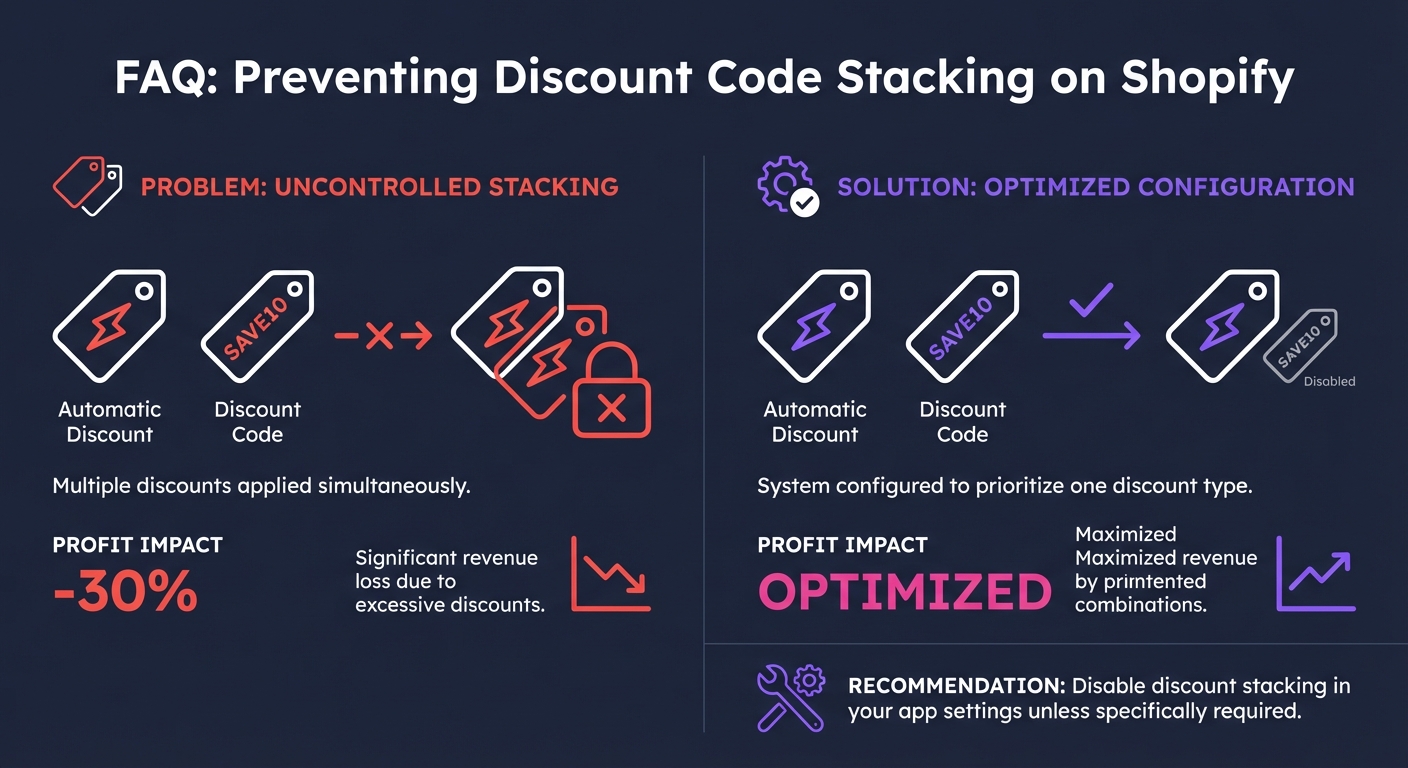
How do I prevent discount codes from stacking with automatic discounts?
Configure your system to prioritize one discount type. Set automatic discounts to supersede manual codes, or allow customers to choose the better deal. Most apps have settings for "discount stacking" where you can enable or disable code combinations. I recommend disabling stacking unless you specifically want it. Display a message at checkout explaining why codes cannot combine when automatic discounts are active.
Can I run different promotions for different customer groups simultaneously?
Yes. Tag customers into segments like VIP, new customer, or wholesale. Create separate automatic discounts for each tag. The system applies the appropriate discount based on customer tags. I set this up for clients regularly. One clothing brand runs four different discount levels simultaneously based on customer lifetime value. Each customer sees only their applicable pricing.
What happens if my automated promotion breaks during a flash sale?
Have a backup plan. Keep a manual discount code ready to share if automation fails. Monitor the first 30 minutes of any major promotion closely. I recommend setting up alerts that notify you immediately if discount application rates drop suddenly. One client had an automation fail during Black Friday. They activated their backup code within eight minutes. Most customers never noticed the hiccup.
How do I automatically end promotions without staying up until midnight?
Schedule end times in your promotion settings. The system deactivates discounts automatically at your specified time. Works for any time zone. I schedule all promotions at least 24 hours in advance. The system handles activation and deactivation while you sleep. One toy store owner scheduled promotions from vacation in Hawaii. Everything ran perfectly without his involvement.
Will automated pricing work with my POS system for in-store purchases?
Yes, if you use Shopify POS. Automatic discounts apply to in-store transactions just like online orders. The POS system syncs with your online store discount rules. I helped a boutique with three retail locations implement this. In-store customers received the same automatic discounts as online shoppers. Sales staff loved it because they did not manually apply discounts anymore.
Can I exclude certain products from automatic promotions?
Absolutely. Use product tags or collections to exclude items. When creating an automatic discount, specify which collections qualify. Items outside those collections are automatically excluded. I typically create a "Never Discount" collection for high-margin or brand-protected items. This prevents accidentally discounting products that should always sell at full price.
How do I track which promotions actually increase profit versus just revenue?
Connect your promotional system to accounting software that tracks profit margins. Compare gross profit dollars during promotional periods versus regular periods. Revenue might increase, but if discounts are too deep, profit decreases. I helped a furniture store discover their 30% off promotions actually decreased profit. We adjusted to 20% off and profit improved while revenue stayed strong.
What is the best way to test new promotional rules before going live?
Create test discount codes that only you can access. Run test orders using different customer accounts and cart scenarios. Verify discounts apply correctly before scheduling them publicly. I always run 10 to 20 test transactions before launching any new promotion. This catches configuration errors before customers see them. Testing takes 30 minutes but prevents expensive mistakes.
Can automated promotions trigger based on cart value or specific product combinations?
Yes. Set conditions like "apply 10% off when cart total exceeds $100" or "give free shipping when cart contains Product A and Product B together." Most apps and native Shopify features support conditional triggers. I use these conditions constantly. A pet store gives free toys when customers buy food and treats together. This encouraged bundle purchases and increased average order value by $23.
How often should I review and update my automated promotional rules?
Review monthly at minimum. Check which promotions perform well and which do not. Adjust discount percentages, timing, or qualification rules based on data. I schedule monthly promotion reviews with clients. We analyze conversion rates, average order values, and profit margins for each promotion type. Then we optimize based on what the data shows. Continuous improvement beats setting promotions once and forgetting them.
Key Takeaways
Shopify automated promotional pricing systems eliminate manual discount updates, saving 15 to 25 hours weekly while preventing costly pricing errors that average $47,000 yearly for stores doing $2M to $10M in revenue.
Set clear discount priority rules to prevent conflicts when multiple promotions run simultaneously. Decide whether discounts stack or if customers receive only the best available discount to protect profit margins.
Native Shopify tools work for simple promotions, but apps provide better ROI for stores doing $2M+ with multiple promotion types. Custom solutions make sense above $8M with unique business needs.
Track critical KPIs including average discount percentage (keep below 12%), promotion conversion rate lift (target 40%+ improvement), and revenue per promotional email (aim for $1.50+ for mid-sized stores).
Integrate promotional pricing with inventory management, email marketing platforms, and accounting software to create seamless automated workflows that protect margins while maximizing revenue opportunities.
Summary
A Shopify automated promotional pricing system handles discount application, conflict resolution, and timing without manual intervention, preventing the pricing errors that cost stores thousands monthly.
The three most common conflicts are flash sales colliding with loyalty discounts, bundle pricing stacking with coupon codes, and volume discounts combining with seasonal sales. Clear priority rules solve all three.
Implementation typically takes four to six weeks including audit, configuration, and testing. Budget $0 for native tools, $20 to $100 monthly for apps, or $8,000 to $25,000 for custom solutions.
Advanced strategies like dynamic inventory-based pricing, customer lifetime value triggers, and AI-powered timing optimization can boost revenue by 30%+ while protecting margins through intelligent automation.
Measure success through average discount percentages, promotional conversion rate improvements, and revenue per email. These KPIs reveal if promotions drive profitable growth or just give away margin unnecessarily.
Our AI ecommerce profit tools can analyze your promotional data and recommend optimal discount strategies that maximize revenue without sacrificing profit. We have implemented automated promotional systems for 50+ Shopify stores doing $1M to $10M annually.
Future-proof your strategy by coordinating discounts across multiple sales channels, implementing AI predictive planning, and building segment-specific promotional journeys that automatically adapt to customer behavior and purchase history.
Disclaimer
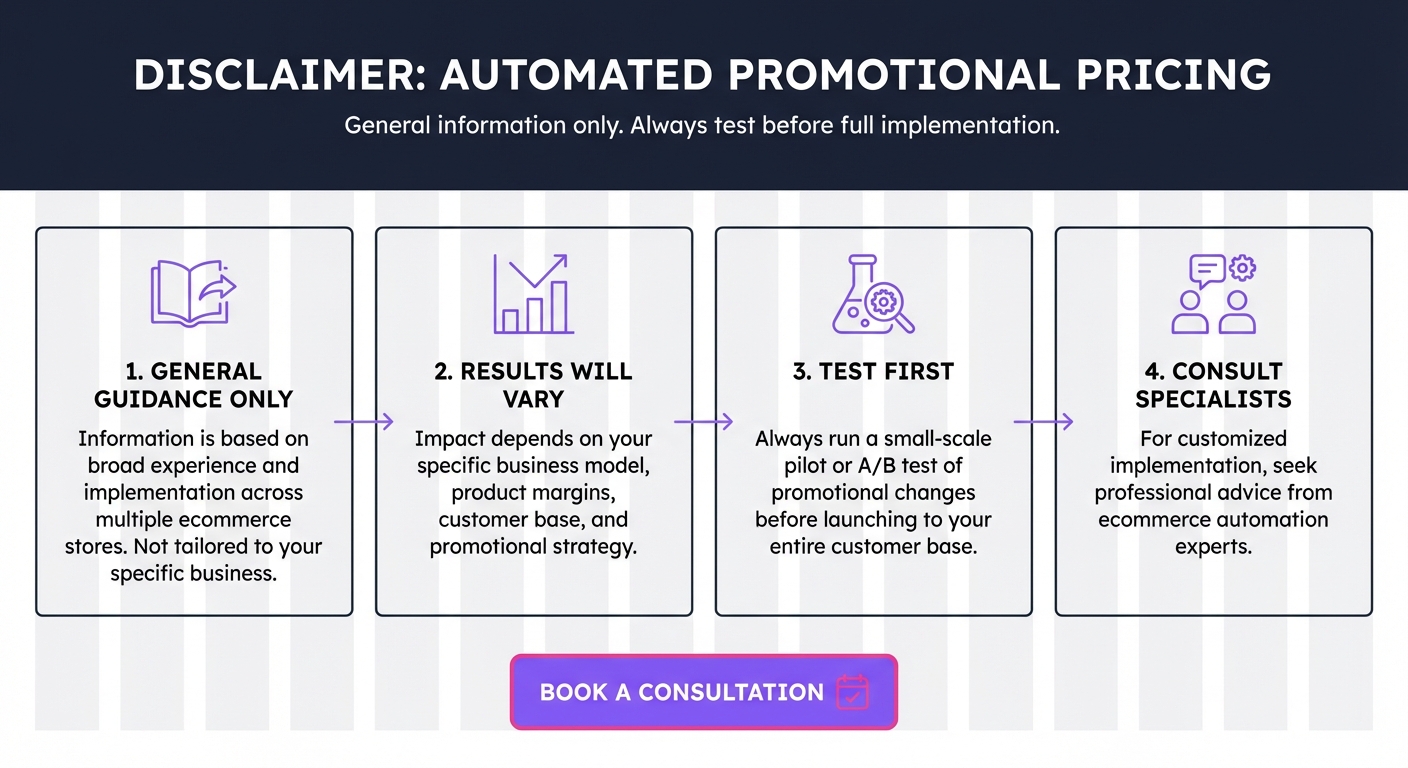
This article provides general information about Shopify automated promotional pricing systems based on implementation experience with multiple ecommerce stores. Individual results vary depending on your specific business model, product margins, customer base, and promotional strategy. Always test promotional changes on a small scale before full implementation. Consult with ecommerce specialists or financial advisors before making significant changes to your pricing strategy. The case studies and numbers mentioned are based on real implementations but have been anonymized to protect client confidentiality.